
Quick Answer
The Cherubim Air Line is a handmade steel aerodynamic bicycle produced by Tokyo-based Cherubim (Konno Cycle Works), founded in 1965. Designed by second-generation master builder Shinichi Konno, the Air Line eliminates all right angles and hard edges from the frame geometry, replacing them with elongated ellipses and flowing curves intended to minimize aerodynamic drag. It is built for velodrome and hour record competition.
Most handmade steel bicycles are celebrated for their ride quality, their geometry, or the precision of their welds. Among Cherubim bicycles, the Air Line is celebrated for something different: it looks unlike any other bicycle ever built. No right angles. No hard edges. No concession to the conventional diamond frame that has dominated bicycle design for over two centuries. What Shinichi Konno created with the Air Line is a fully rideable machine that also functions as a serious argument about the future of aerodynamic bicycle design.
Amazon Affiliate I earn from qualified purchases
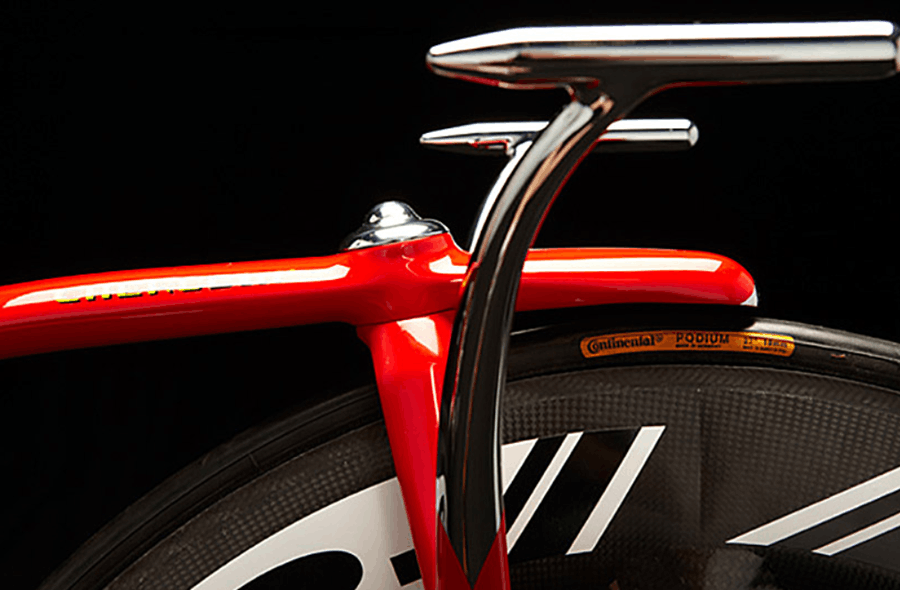
This week’s Bicycle of the Week profile takes a close look at the Cherubim Air Line — its design philosophy, the engineering decisions behind it, and the six-decade history of the workshop that produced it.
The History of Cherubim Bicycles
Cherubim bicycles trace their origin to 1965, when Hitoshi Konno founded the company in what was then a virtually nonexistent custom frame building industry in Japan. According to Subsequence Magazine, the company started out as a garage brand in the most literal sense, but within three years a track bike made by Hitoshi in his tiny workshop had debuted at the 1968 Mexico City Olympics and set a new Japanese national record. That result — just three years after founding — established Cherubim as synonymous with the highest level of Japanese frame building.
The name itself carries meaning. The brand name Cherubim was chosen by Hitoshi’s mother, a Christian, and the angelic name was intended to give wings not only to the riders of Cherubim bicycles but to their family members as well. Hitoshi’s approach to frame building became legendary within the industry. Industry insiders referred to his passionate approach as “welding mania,” as he continued to churn out novel ideas and revolutionary designs throughout his career.
The Konno family’s influence on Japanese frame building extended beyond Cherubim. Three Konno brothers and their frames — Cherubim, 3Rensho, and Miyuki — led the early age of the frame building industry in Japan. Cherubim is the only surviving brand carrying the family tradition forward. Cherubim bicycles also won seven consecutive Best Handmade Bicycle Awards from 1998 to 2005 at the prestigious annual show sponsored by the Japan Cycling Association.
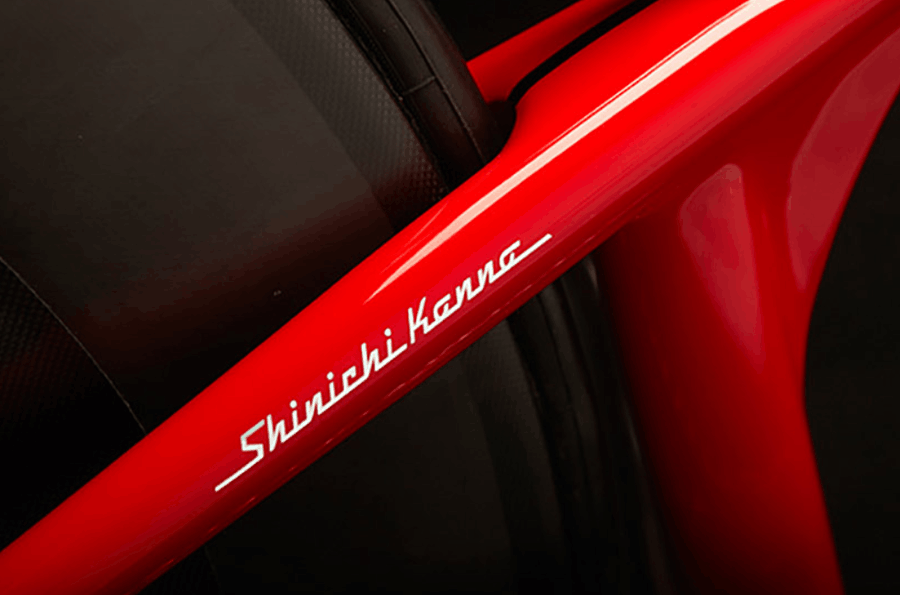
After Hitoshi retired, his son Shinichi Konno took over. Shinichi operates from the belief that the best bike is a custom steel frame that can be adapted to the rider’s physique, riding style, and preferences — creating bikes of functional beauty that combine the best ride with a shape that appeals to the rider at a high level, without being bound by existing ideas. Today Cherubim operates from a workshop in Machida, a suburb of Tokyo, producing made-to-order chromoly steel frames one at a time.
The Air Line: Design Philosophy
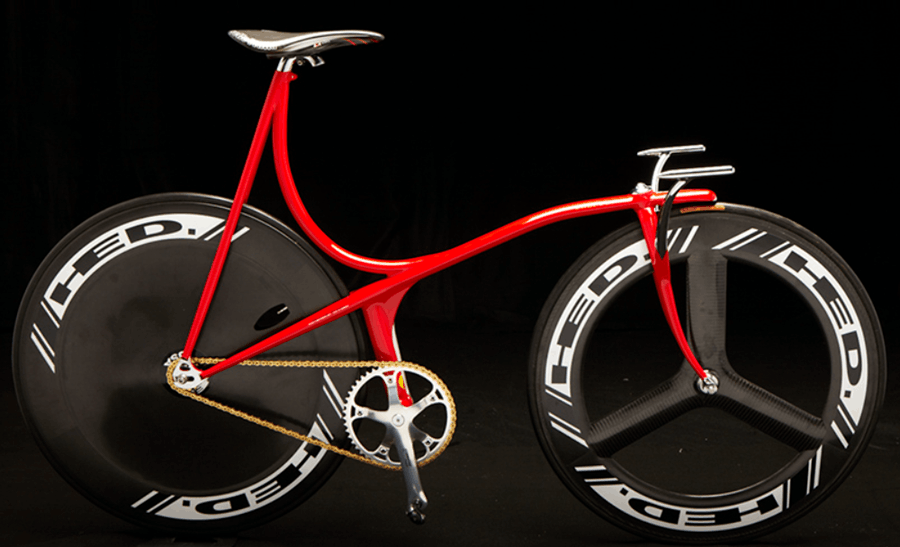
The Cherubim Air Line is not a production bicycle. It is a concept machine, built to challenge the foundational assumption that a bicycle frame must consist of straight tubes joined at angles. Every element of the Air Line’s design flows from a single aerodynamic principle: eliminate anything that creates a hard edge against moving air.
As reported by Designboom, the Air Line’s minimalist form is designed to avoid the right angles and hard edges that cause air resistance in conventional bicycles. Instead it rides on undulating lines and elongated ellipses — a frame geometry that draws more from fluid dynamics than from traditional bicycle engineering. The result is a machine that appears to have been shaped by wind rather than built by hand.
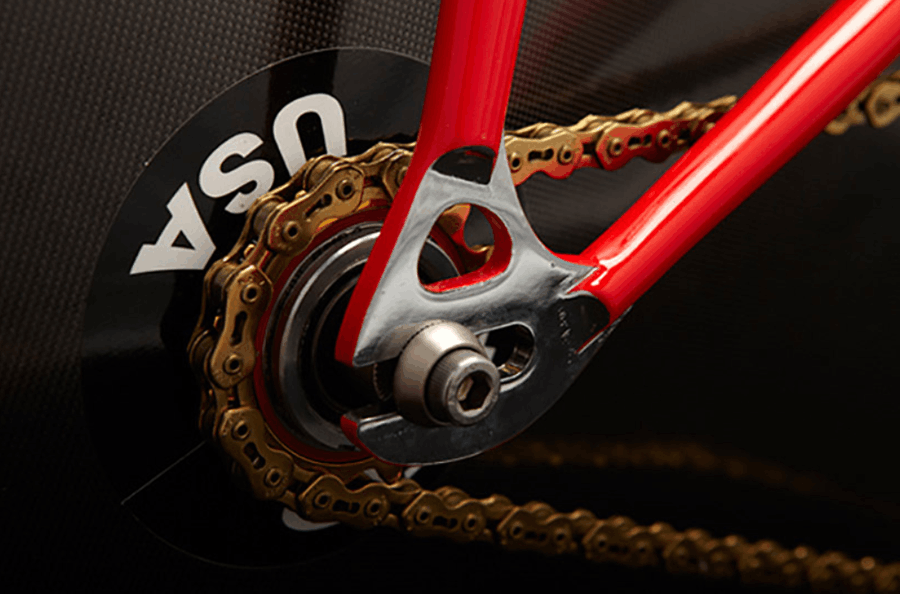
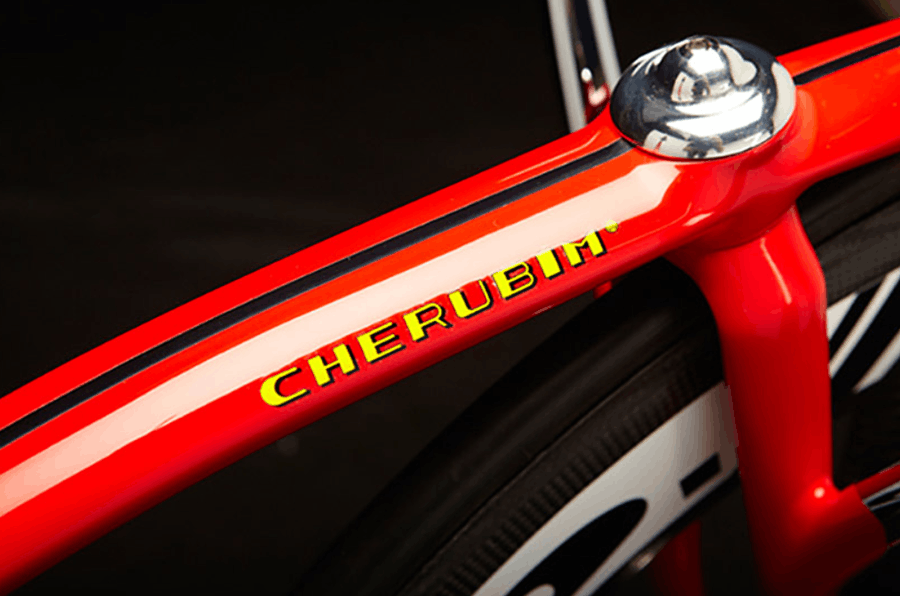
The frame is finished in a deep red coat with chrome accents. There are no visible welds in the conventional sense — the transitions between tubes dissolve into curves, making it genuinely difficult to identify where one structural element ends and another begins. The Air Line features an integrated electrical shifting system and 31.8 steel seat tubing, permitting the rider to maneuver efficiently while the low wind drag allows for optimal speed.
Sponsored · Competitive Cyclist
If aerodynamics drives your equipment decisions as much as it drove the Air Line’s design, browse aero helmets at Competitive Cyclist.
What Konno Set Out to Solve
Shinichi Konno has been direct about the engineering problem the Air Line was built to address. The conventional diamond frame — a design with over 200 years of documented history — is structurally efficient but aerodynamically compromised. Every junction, every tube angle, every abrupt transition creates turbulence. For road racing in a peloton, that drag is manageable. For solo events like the hour record or velodrome time trials, it represents a measurable and addressable performance loss.
Konno’s position on this is unambiguous. In his own words: “Aerodynamics is the largest theme in bicycle history all the time. Cherubim created this bike by breaking the regulations and traditional concepts, because we believe this is the only way to expand the horizon of bicycle design. We’re too wedded to the traditional diamond-shaped bike. Air Line presents the new possibility for the race like the hour record and velodrome time trials.”
This is not a decorative claim. The UCI’s regulations for competitive cycling prohibit many frame designs that deviate significantly from the traditional diamond shape — which is precisely the point. Konno built the Air Line outside those constraints intentionally, as an exploration of what is physically possible when regulations are removed from the design process. The resulting machine is as much a research object as it is a bicycle.
Construction and Materials
Despite its unconventional appearance, the Air Line is built using the same fundamental material that defines all Cherubim bicycles in production: chromoly steel. All Cherubim frames are made from chromoly steel, a special alloy composed of chromium and molybdenum. In contrast to more common carbon or alloy frames, individually hand-welded chromoly tube frames require a high level of skill to produce, and are becoming scarce even in European ateliers.
Chromoly is a deliberate choice for Konno, not a compromise. The material’s properties — its elasticity, its ability to be formed into complex shapes, its response to skilled welding — make it uniquely suited to the organic geometries the Air Line demands. Carbon fiber, while lighter, does not bend and flow the way chromoly can under the hands of a skilled builder. The Air Line could not exist as a carbon frame.
Cherubim bicycles are made to order. Based on a rider’s height and cycling needs, a builder will assemble the frame to exacting specifications. The workshop in Machida operates with a small team, and the hand-built works of Cherubim bicycles have won numerous international accolades including awards from the Hand Made Cycle Fair in Japan and the North American Handmade Bicycle Show (NAHBS).
Sponsored · Competitive Cyclist
For the track and time trial cyclist who appreciates purpose-built equipment, browse road and track bikes at Competitive Cyclist.
The Air Line in Context
The Air Line did not emerge in isolation. Shinichi Konno has a history of producing experimental frames that challenge conventional geometry while competing alongside his mainstream chromoly production work. His Silver Flyer track bike won both Best in Show and the President’s Choice award at the North American Handmade Bicycle Show. The Air Line represents a continuation of that same experimental impulse taken further — to the point where the frame no longer resembles a bicycle in any conventional sense.
What separates the Air Line from purely aesthetic bicycle art projects is that it remains functional. It is fitted with real components, real gearing, real contact points. Konno built it to be ridden, not displayed — though it has been displayed extensively and photographed widely since its introduction. The tension between those two identities — art object and race machine — is part of what makes it one of the most discussed frames in contemporary handmade bicycle building.
For collectors and enthusiasts of classic and contemporary Japanese bicycle craftsmanship, the Air Line represents the current outer edge of what Cherubim bicycles’ six-decade tradition of handmade steel frame building has made possible. It is, in both literal and figurative terms, what happens when a master builder stops asking whether something is allowed and starts asking whether it is possible.
Plan Your Race Day and Ride Day Nutrition
Use our free Race & Ride Day Nutrition Planner to dial in your fueling strategy — fluid intake, sodium, and calories calculated for your body weight and conditions.
Frequently Asked Questions
Who makes the Cherubim Air Line bicycle?
The Air Line is made by Cherubim, also known as Konno Cycle Works, a handmade steel bicycle workshop based in Machida, Tokyo. It was designed and built by Shinichi Konno, the second-generation master builder who took over the company from his father Hitoshi Konno, who founded Cherubim in 1965.
What makes the Cherubim Air Line different from other bicycles?
The Air Line eliminates all right angles and hard edges from the frame, replacing conventional straight-tube diamond geometry with elongated ellipses and continuous flowing curves. The design is intended to minimize aerodynamic drag for velodrome and hour record competition. It is built from hand-welded chromoly steel and is made entirely by hand in Cherubim’s Tokyo workshop.
Is the Cherubim Air Line a rideable bicycle or a display piece?
It is a fully functional bicycle. Despite its sculptural appearance, the Air Line is fitted with real drivetrain components including an integrated electrical shifting system and is built to be ridden on the velodrome. Shinichi Konno has stated that the bike was designed specifically with the hour record and velodrome time trials in mind, not as a display piece.
James Hickman is a former USA Cycling Expert-level coach who has worked with cyclists at every level, from beginners to competitive racers. He served as a coach for the Leukemia & Lymphoma Society’s Team In Training program, helping riders prepare for and complete century events. A Masters-category racer himself, he competed and earned podium finishes in Southern California events and holds a Platinum finish at El Tour de Tucson, completing the 100+ miles in under five hours.
Related Reading
Sponsored · Competitive Cyclist
We are an Amazon affiliate and earn from qualified Amazon purchases with no cost to you. This is for ANY product that you purchase through our links. We are also an affiliate for Competitive Cyclist and JensonUSA. This way we can provide you with competitive pricing and products.