
Contents
1987 Team Fuji Funny Bike
Quick Answer
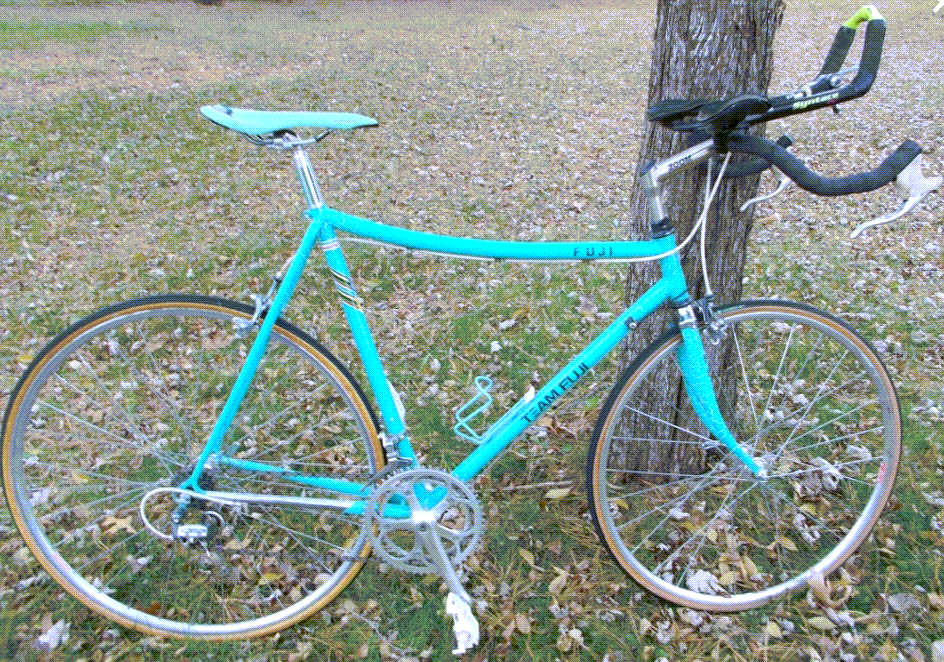
What is the 1987 Team Fuji Funny Bike? The 1987 Team Fuji Funny Bike is a hand-built, lugless Japanese steel racing bicycle constructed from Ishiwata 019E chromoly tubing, distinguished by a curved top tube and dual wheel sizes — a small-diameter front wheel paired with a standard 700c rear wheel. It was the only “funny bike” Fuji ever produced, built during a two-year window before the UCI banned dual-wheel-size bicycles from official record-keeping in 1989.
A Two-Year Window in Cycling History
In 1987, Fuji occupied a narrow but significant moment in competitive cycling. The “funny bike” configuration — pairing a smaller front wheel with a full-size 700c rear wheel — was legally sanctioned for time trials and hour records, and manufacturers were racing to capitalize on the aerodynamic advantages the format offered. Fuji built exactly one model: the 1987 Team Fuji Funny Bike. By 1989, the UCI had eliminated dual-wheel-size configurations from official record eligibility, closing that window permanently.
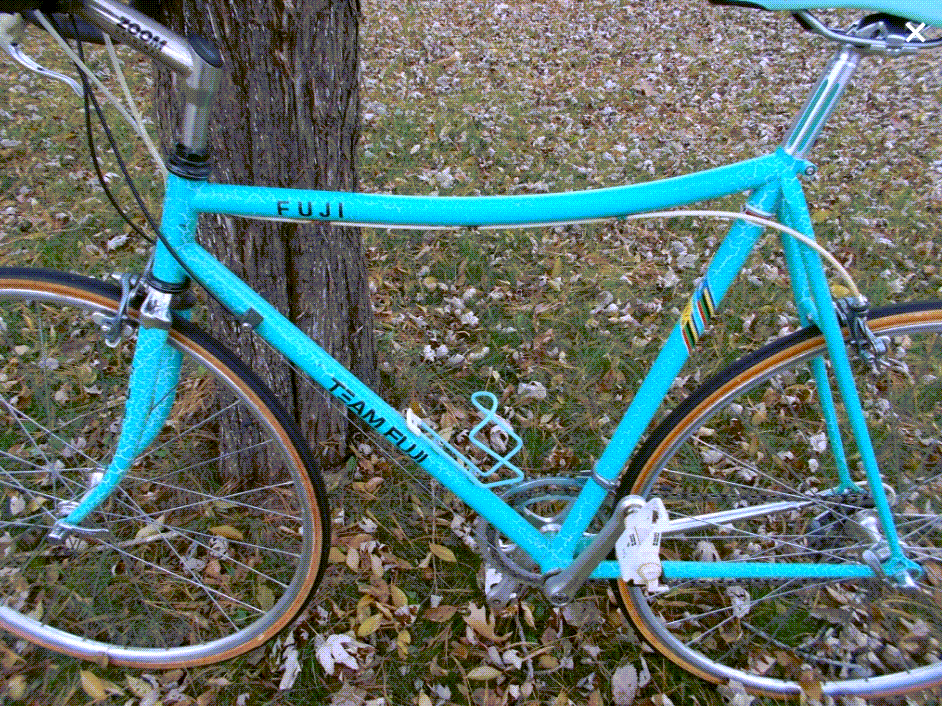
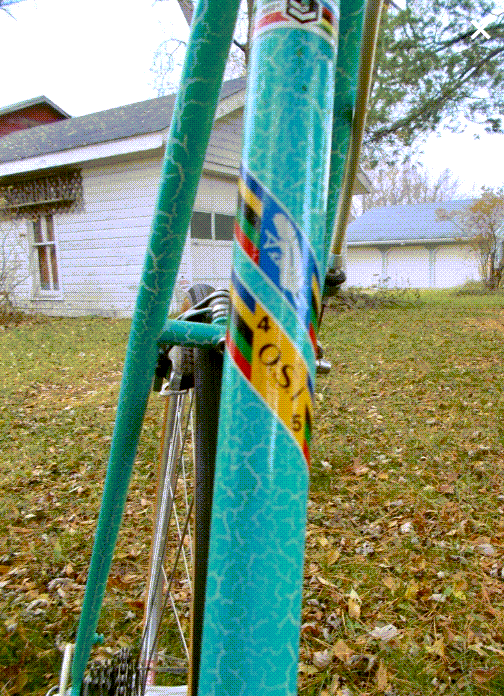
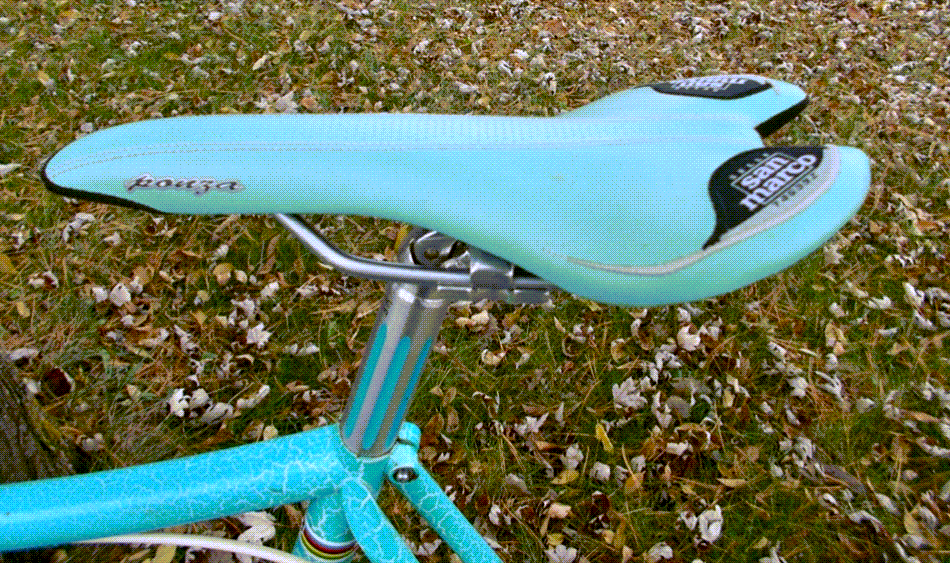
The bicycle documented at Dahlquist Cycleworks represents a surviving example of this rare model in its original crackle finish, acquired and preserved without alteration from its previous owner’s component configuration.
The Funny Bike Concept: What It Was and Why It Mattered
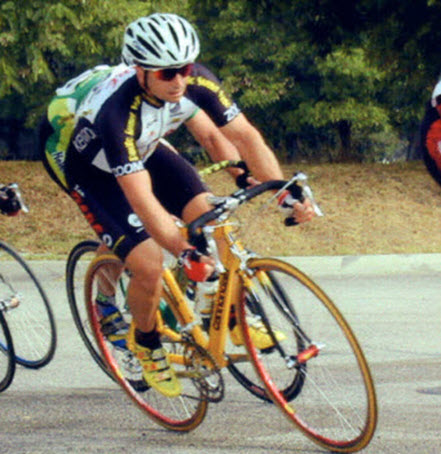
A “funny bike” is defined by its mixed wheel diameters. The front wheel is typically a 24-inch tubular or 650c rim, while the rear uses a standard 700c wheel. This asymmetric configuration lowered the front end of the bicycle, reducing the frontal area presented to the wind and allowing a more aggressive, aerodynamically efficient rider position — similar in effect to what a cowhorn-style handlebar achieved when paired with aero bars.
The rear wheel remained at 700c for practical reasons. A smaller rear wheel would require impractically large chainring tooth counts to maintain competitive gear ratios, and the larger diameter also contributes to lower rolling resistance over distance.
By the late 1980s, funny bikes were in active use across time trials, velodrome pursuits, and team time trial events. The small front wheel was especially valued in team time trial applications, where riders could draft in much closer proximity off the wheel directly ahead. Fuji, Nishiki, Shogun, and other Japanese manufacturers each offered variants, though most were configured differently. The 1987 Team Fuji is notable for its curved top tube — a departure from the conventional straight-tube geometry that Fuji returned to with its 1988 Team Fuji time trial model.
Frame Construction: Ishiwata 019E Tubing
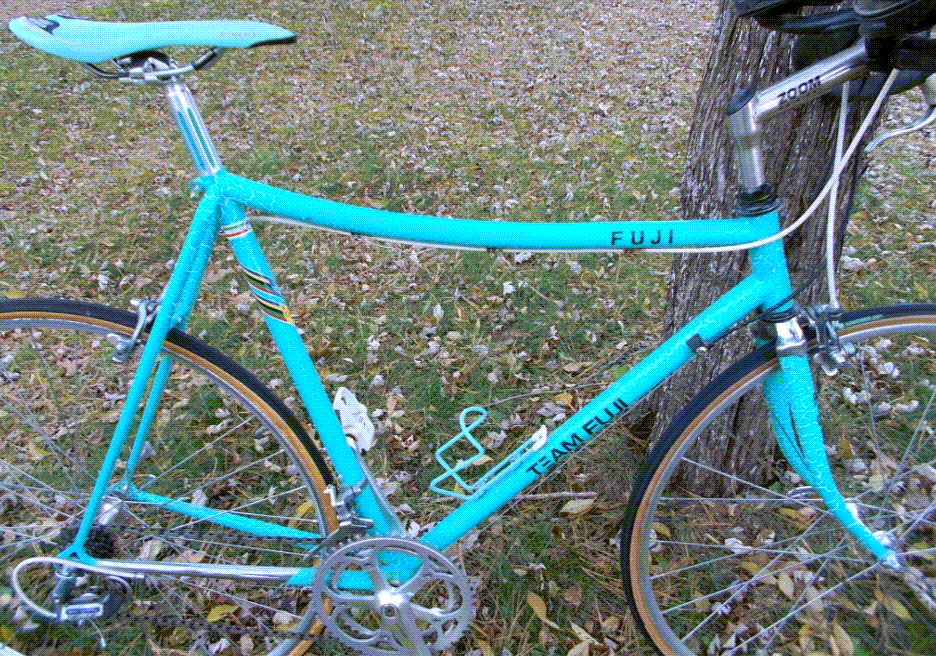
The 1987 Team Fuji is hand-built using Ishiwata 019E chromoly steel tubing, a specification that places it firmly in the upper tier of Japanese steel construction from the era.
|
Ishiwata 019 tubing — the base designation — is a seamless, double-butted chromoly set drawn to 0.8mm/0.5mm/0.8mm wall thicknesses. The name “019” directly references the tube set weight: 1.9 kilograms for the complete main triangle set, equivalent in mass and material composition to Columbus SL tubing. The “E” suffix indicates a seamed variant, as Ishiwata produced both seamless and seamed iterations of its numbered grades. Despite the seamed construction, the material properties and ride characteristics were functionally equivalent; Ishiwata’s finish quality was frequently cited as superior to comparable European tubes of the period.
Ishiwata supplied tubing to a broad range of frame builders worldwide — Bianchi, Trek, Bridgestone, Peugeot, Schwinn, and Raleigh among them — but it was particularly embedded in Japanese competitive cycling, where it was specified for Keirin-certified frames and top-tier production racing bikes. The company ceased operations in 1993, with much of its expertise transferring to Kaisei, which continues producing butted steel tubing today.
The 1987 Team Fuji frame is lugless, meaning the main triangle joints are constructed without the bronze or steel lugs used in traditional frame assembly. By 1987, as noted in Japanese Steel: Classic Bicycle Design from Japan (Bevington and Ryder, 2018), lugless construction had become part of Fuji’s technical vocabulary for its high-performance offerings — a reflection of the broader industry shift toward fillet-brazed and TIG-welded construction that offered greater geometric flexibility.
Component Specification
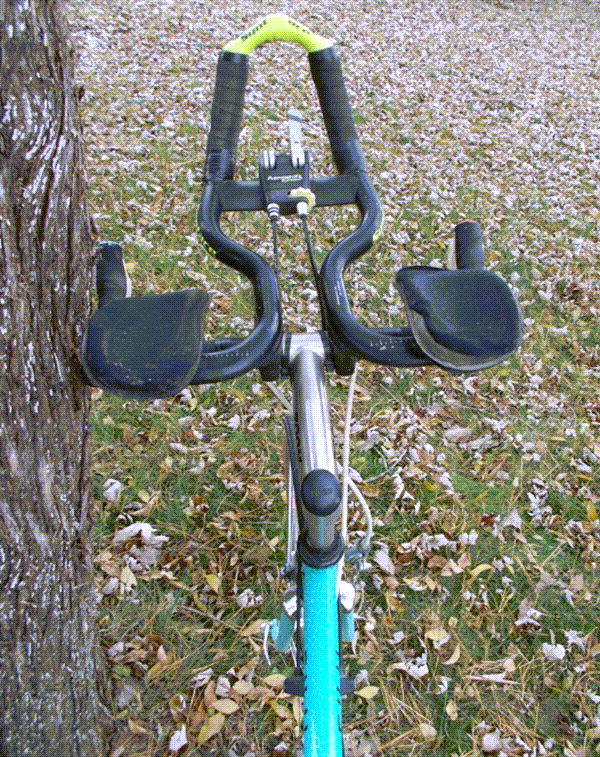
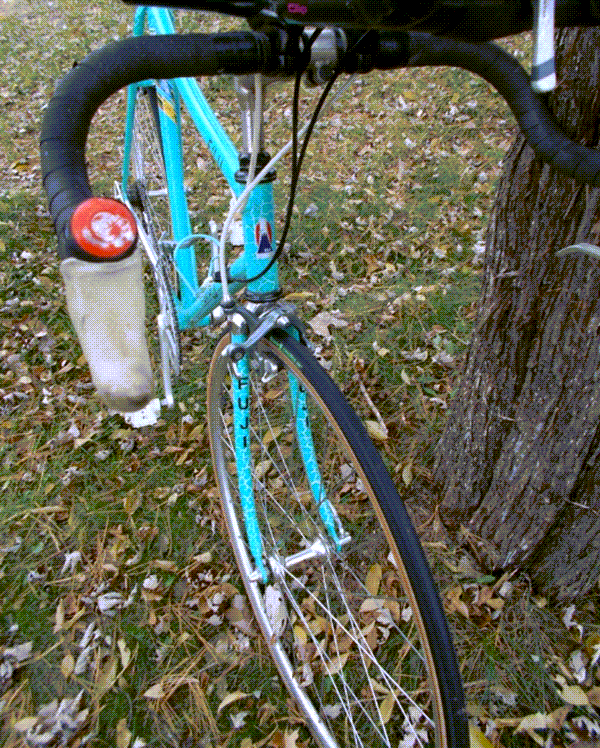
The example preserved at Dahlquist Cycleworks retains components selected by its previous owner. The original groupset may have been Shimano Santé, a compact mini-groupset Fuji offered on the 1987 Team models, though this cannot be confirmed with certainty for this specific bicycle. The crackle finish paint — period-correct for the model — remains intact.
The 1987 version is distinguishable from the 1988 Team Fuji (also documented at Dahlquist Cycleworks) by its curved top tube. The following year’s model reverted to a straight top tube, representing a different design philosophy while sharing the time trial intent.
Frequently Asked Questions
Why did the UCI ban dual-wheel-size bicycles? The UCI eliminated dual-wheel-size configurations from official record eligibility in 1989 as part of a broader effort to standardize bicycle specifications in sanctioned competition. Funny bikes were never legal for mass-start road or track racing; their use was limited to individual time trials, pursuit events, and hour records. As aerobars and other equipment gained traction in the early 1990s, the UCI progressively tightened equipment rules, culminating in a comprehensive ban on non-standard configurations in the late 1990s.
What makes the 1987 Team Fuji unique among Fuji’s lineup? It is the only funny bike Fuji ever produced. The curved top tube on the 1987 model further distinguishes it from any other Fuji time trial bicycle. Fuji’s 1988 Team model — a straight-tube time trial bike — and the 1985 Opus III represent adjacent high-performance models in the company’s catalog, but neither shares the funny bike configuration or the curved top tube geometry.
Is Ishiwata 019E tubing comparable to Columbus SL or Reynolds 531? Yes. Ishiwata 019 tubing is drawn to the same wall thickness specification as Columbus SL (0.8/0.5/0.8mm) and weighs 1.9 kilograms per set — identical to Columbus SL’s claimed weight. Material composition is chromoly steel, equivalent in tensile strength and post-brazing characteristics to both Columbus and Reynolds 531 of the period. The “E” suffix denotes seamed construction, which does not compromise structural integrity in bicycle frame applications.
James Hickman is a former USA Cycling Expert coach, Leukemia & Lymphoma Society’s Team N Training coach and Masters category racer with podium finishes in So Cal events.
The 1987 Team Fuji Funny Bike is part of the Japanese bicycle collection at Dahlquist Cycleworks. Related models in the collection include the 1988 Team Fuji Time Trial and the 1985 Fuji Opus III.
Sponsored · Competitive Cyclist
Some links on this page are affiliate links. If you click through and make a purchase from Amazon, Competitive Cyclist, or Jenson USA, we may earn a small commission at no additional cost to you. We only link to products and retailers we genuinely recommend. This helps support the site and keeps the content free.